 views
views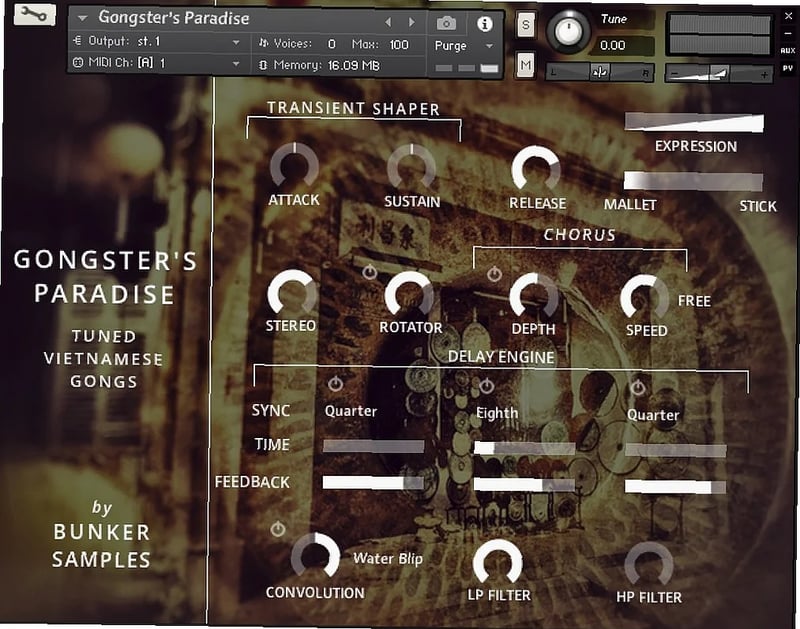
Transform the sonic landscape of your composition as you strike a virtual gong in a dimly lit studio, the resonance swelling beyond physical possibility—layered, evolving, shaped not just by motion but by intention.
Exploring the Digital Evolution of Traditional Vietnamese Gongs
The integration of traditional acoustic instruments into digital environments has opened new dimensions in sound design. Among these, the Vietnamese gong holds a unique cultural and sonic significance. Modern virtual instruments now capture five meticulously tuned Vietnamese gongs, preserving their organic tonal character while expanding their expressive potential through digital enhancement.
These sampled gongs are not static recordings; they are dynamic sound sources designed for real-time control. The core innovation lies in the seamless transition between playing techniques—specifically, the use of a hammer versus a stick to excite the gong surface. In acoustic performance, switching between these articulations requires physical repositioning and alters attack dynamics significantly. However, within this virtual instrument, such shifts occur fluidly via an articulation slider.
Mastering the Articulation Slider for Expressive Control
The articulation slider serves as a morphing control between two distinct striking methods:
- Hammer mode: Produces a deep, resonant attack with extended sustain and rich harmonic decay.
- Stick mode: Delivers a sharper, more focused onset with brighter overtones and quicker transient response.
By adjusting the slider in real time, performers can blend these articulations continuously, enabling gliding transitions that would be unattainable with physical instruments. This capability allows composers to craft evolving textures—such as a strike that begins with percussive clarity and blooms into a dark, reverberant wash—within a single note event.
Advanced Sound Manipulation Tools
Beyond articulation blending, the instrument provides a suite of sound-shaping modules designed for creative exploration:
- Spectral Shifter: Alters the harmonic profile post-trigger, allowing pitch drift, inharmonic stretching, or metallic timbral shifts.
- Resonance Damping Control: Simulates physical damping techniques, from hand pressure to mallet muting, controllable via MIDI CC or envelope follower.
- Convolution Reverb Engine: Integrates impulse responses from sacred spaces and natural environments, enhancing spatial authenticity.
- LFO-Modulated Pan and Width: Introduces slow, sweeping movement ideal for ambient layers and cinematic underscoring.
These tools operate independently per voice, supporting polyphonic expression when multiple gongs are triggered simultaneously. Automation of parameters within a digital audio workstation (DAW) enables precise scripting of sonic evolution across time.
Workflow Integration and Performance Techniques
To fully leverage the instrument’s capabilities, consider the following implementation strategies:
| Technique | Application | MIDI Control Assignment |
|---|---|---|
| Real-time articulation sweep | Film score swells, ritualistic transitions | Modulation wheel or aftertouch |
| Automated spectral shift | Ambient drones, psychological tension cues | CC18 with envelope shaping |
| Polyphonic damping sequences | Rhythmic punctuation with decaying tails | Note-off velocity mapped to damping speed |
For live performance, mapping the articulation slider to a continuous controller (e.g., ribbon controller or expression pedal) ensures tactile responsiveness. When scoring to picture, automation lanes in the DAW allow frame-accurate modulation of timbral characteristics.
Creative Applications in Composition
This virtual gong instrument excels in genres requiring atmospheric depth and cultural resonance:
- Cinematic soundtracks: Use gradual articulation shifts to underscore emotional transitions.
- World music fusion: Layer processed gong tones with ethnic wind or string instruments.
- Sound design for media: Extract and repurpose gong transients as impact elements or UI sounds.
Because each gong is individually tunable, microtonal scales or custom pentatonic arrangements can be constructed to reflect regional tuning systems.