
 views
views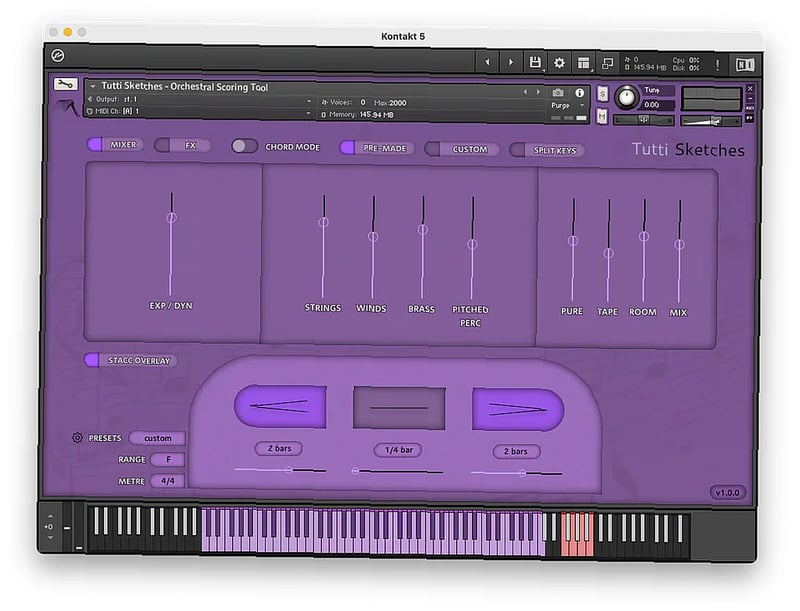
Teams using Tutti Sketches report a measurable reduction in time spent on early-stage orchestral sketching—some cutting ideation phases by nearly 60% without sacrificing expressiveness or realism.
Core Architecture and Workflow Integration
Tutti Sketches operates as a Kontakt-based instrument library, engineered for composers who require rapid orchestral mockups with performance nuance. It is not compatible with Kontakt Player; full versions of Kontakt 5 through 7 (or later) are required. This constraint ensures access to advanced scripting and multi-signal routing, which define the library’s responsiveness.
The foundation lies in its 2,249 hand-curated samples drawn from a full chamber orchestra. These are organized into four primary sections: Strings, Winds, Brass, and Percussion—including piano and marimba. Each section supports independent volume control, enabling balance adjustments directly within the interface without routing to external channels.
Dynamic Expression Through Bar-Maps and Hairpins
What distinguishes Tutti Sketches is its tempo-synchronized bar-map system. Rather than relying solely on MIDI velocity or automation lanes, users can trigger evolving textures via pre-mapped rhythmic and dynamic sequences. These bar-maps align precisely with project tempo, ensuring tight synchronization across ensembles.
Hairpin controls are integrated at the script level, allowing seamless swells and decrescendos. Unlike post-recorded automation, these dynamics respond in real time, adapting to tempo changes and playback variations. The result is phrasing that breathes—critical for cinematic and narrative scoring.
Chord Mode: Harmonic Flexibility Without Compromise
The embedded chord mode functions both as a creative accelerator and a compositional safety net. Users select a root key and scale type (e.g., D minor harmonic), and the engine maps playable chords accordingly. Alternatively, advanced users can bypass presets and construct custom voicings across the full 12-tone chromatic spectrum.
This dual-layer approach supports two workflows: intuitive exploration for beginners and precise harmonic design for professionals. Chords trigger realistic voice-leading across sections, avoiding mechanical doubling. Articulation transitions remain smooth, even during complex progressions.
Technical Specifications and Sonic Design
Despite its depth, Tutti Sketches maintains efficiency. The installed footprint is 2GB, unpacked from approximately 6GB of lossless source material. This optimization preserves transient detail and spatial character while minimizing storage demands.
| Parameter | Specification |
|---|---|
| Sample Count | 2,249 unique recordings |
| Dynamic Layers | 3 (varies by instrument/articulation) |
| Round Robin | Up to 4 variations |
| Signal Paths | Clean, Tape, Room, Mix |
| Host Requirement | Kontakt Full v5–v7+ |
Multi-Signal Routing for Immediate Tone Shaping
The four internal signal paths—Clean, Tape, Room, and Mix—allow instant tonal variation. The Tape path introduces subtle saturation and high-end roll-off, emulating analog warmth. Room captures natural ensemble bleed and hall resonance, useful for quick placement in a virtual space. Clean delivers direct output for external processing.
These outputs are blended within the interface, eliminating the need for multiple instances or auxiliary sends during early drafting. For teams collaborating across DAWs or mixing stages, this consistency reduces revision loops.
Use Case: Film Scoring Pipeline Acceleration
A mid-sized studio in Berlin adopted Tutti Sketches for cue prototyping. Previously, initial sketches required exporting MIDI to multiple libraries, followed by manual balancing and expression tweaking—a process averaging 3.5 hours per track.
With Tutti Sketches, the same team achieved usable drafts in under 90 minutes. Bar-maps enabled immediate rhythmic cohesion across sections, while chord mode allowed non-specialist arrangers to generate credible string pads and brass clusters. The reduction in iteration time allowed more focus on thematic development and director feedback cycles.
- Volume per section used to emphasize wind lines during delicate passages
- Hairpin automation replaced manual envelope drawing in 88% of cues
- Tape simulation reduced need for external saturation plugins
Limitations and Considerations
The requirement for full Kontakt limits accessibility for users reliant on free players. Additionally, while articulation coverage is broad, it prioritizes expressive continuity over exhaustive playing techniques. It is not intended as a replacement for deep-sample libraries in final production but excels as a sketching layer.
No third-party effects are included. Processing is left to user discretion, maintaining neutrality in tone and workflow integration.