
 views
views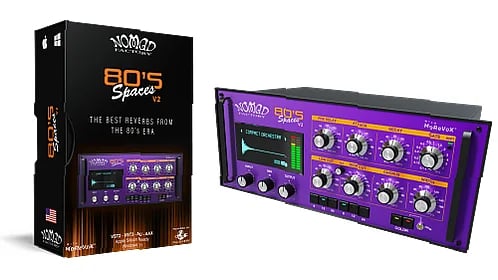
Designers and audio engineers chasing that unmistakable 1980s spatial depth often hit a wall: modern reverbs lack the character, and vintage hardware is prohibitively expensive or unavailable. Emulating the sonic footprint of records by Michael Jackson, U2, or Madonna isn’t just about reverb—it’s about capturing an era defined by gated tails, bright plates, and cavernous halls processed through analog signal chains.
Authentic 80s Reverb in Convolution Form
Developed by Nomad Factory in collaboration with Plugivery and MoReVox, 80s Spaces v2 leverages convolution technology to deliver precise emulations of the reverb units that shaped a generation. The plugin integrates 300 high-resolution impulse responses (IRs), sourced from 15 iconic processors used throughout the 1980s. These include legendary units like the Lexicon 480L, EMT 250, AMS RMX16, Yamaha SPX90, and Roland SRV-2000—each IR captured to preserve the tonal color, decay behavior, and modulation characteristics of the original hardware.
Core Features at a Glance
- 300 high-quality convolution impulse responses
- 15 reference reverb models from vintage digital units
- 330 factory presets, logically organized by application and source
- Pre-delay, gate, chorus, width, and hi/low-pass filtering controls
- Dry/wet mix with real-time level metering
- Resizable GUI (up to 200%) for improved visibility
- Intelligent waveform display showing IR shape and envelope
Interface and Workflow
The plugin is structured into four intuitive sections: Reverb, Effect, Mix, and Display. This modular layout streamlines access to both global and fine-tuned parameters, making it suitable for fast recall in production environments.
Reverb Section
This panel gives direct control over temporal aspects of the reverb. Pre-delay can be adjusted to separate the dry signal from the early reflections—a staple in 80s drum production. Decay length and gating are fully adjustable, allowing users to recreate the sharp, truncated tails heard on Phil Collins-style gated reverbs. The 15 modeled units are selectable here, including:
- Lexicon 224 & 480L (Iconic series)
- AMS RMX16 (Retro MX16)
- Yamaha SPX90 and Rev7 (Japanese series)
- Roland DEP5 and SRV-2000 (ROL series)
- Alesis Midiverb II and Quadraverb
Effect Section
Here, tone shaping takes center stage. High- and low-cut filters allow sculpting of reverb brightness and low-end buildup—critical when blending dense mixes. A stereo width control adjusts spatial diffusion, while an integrated chorus module adds movement reminiscent of modulated plates. Additional color EQ and tilt filters provide subtle tonal shifts, mimicking the frequency response quirks of aging analog circuitry.
Mix and Display
The Mix section handles input gain, output level, and dry/wet balance—essential for maintaining headroom and clarity. The Display area features a dynamic waveform overview that visualizes the selected IR’s envelope, helping users identify gated, plate, or hall types at a glance. Real-time level meters monitor both input and output signals, reducing the risk of clipping during heavy processing.
Sonic Performance and Use Cases
Where 80s Spaces v2 excels is in genre-specific authenticity. Drums benefit immensely from the gated IRs, especially those modeled after the AMS RMX16 and Yamaha SPX90—units famously used on snare tracks in the 80s. Vocals gain dimension through smooth plate emulations derived from the EMT 250 and Lexicon PCM70. Ambient textures and synth pads come alive with long decays from the Eventide H3000 and Lexicon 480L captures.
The 330 presets are well-curated, tagged by instrument type and effect style (e.g., 'Gated Snare – MJ Style', 'Bright Plate – Madonna Vocals'). This organization reduces trial-and-error, making the plugin viable for tight deadlines.
Installation and Compatibility
Supports VST, VST3, and AAX formats, compatible with major DAWs on Windows. Installation requires administrator privileges. Users upgrading from earlier versions should uninstall legacy builds unless previously installed via the same distribution method. After installing the main plugin, authorization is handled through Plugivery’s keygen utility, which generates a license based on system ID. Antivirus software may flag the keygen as suspicious—temporary disablement may be required during registration.
Note: Specific file sizes, system requirements, and pricing details are not provided in the source material and therefore omitted to maintain accuracy.